
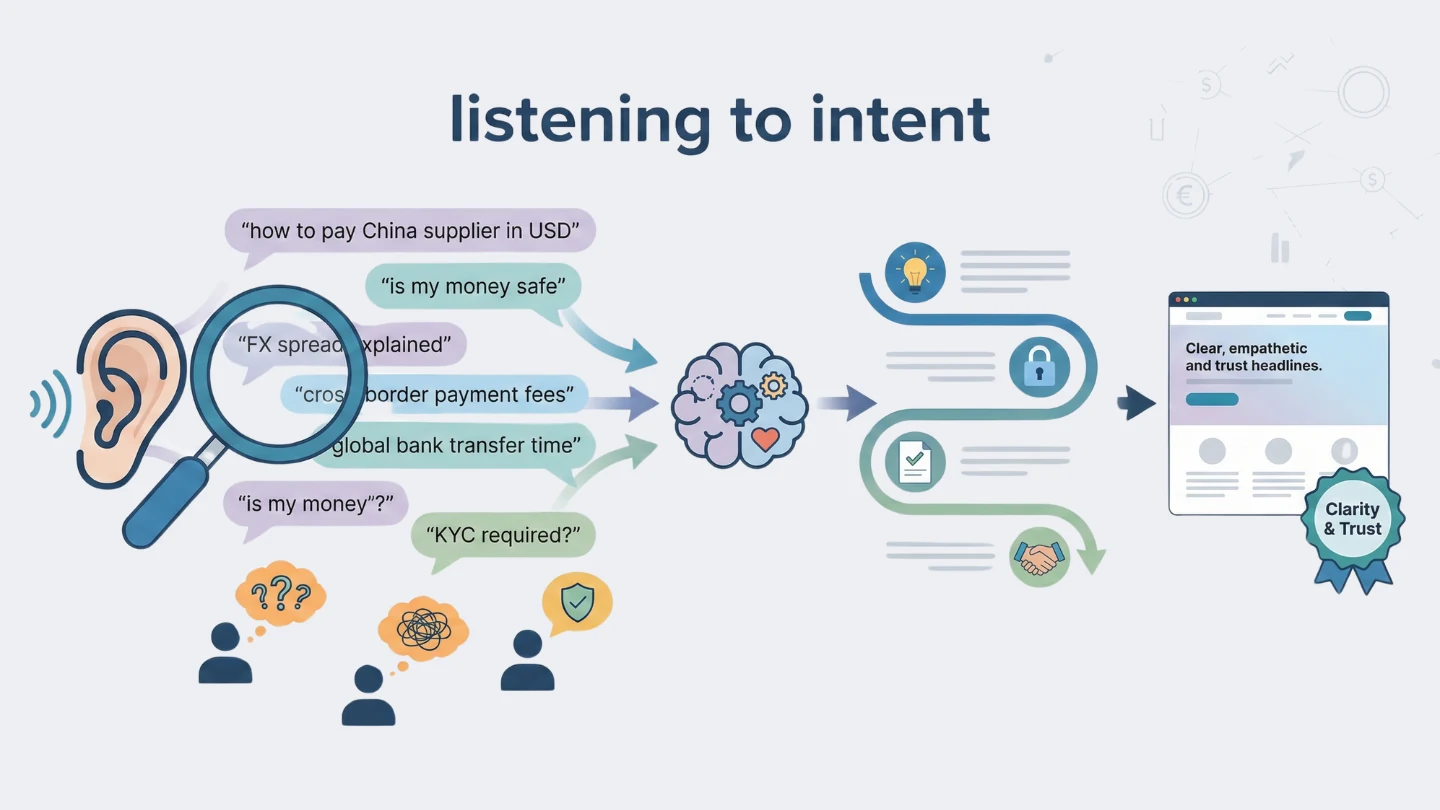
Keyword research in fintech is one of those things that looks straightforward on the surface, but never behaves the way the textbooks say it should. Every time I sit down to map a new product line or landing page, I’m reminded that fintech keywords live in their own ecosystem. The search volume is usually lower, the intent signals are messier, and the things people actually type rarely match the industry vocabulary we use internally. So I’ve learned to approach it less like a checklist exercise and more like a kind of fieldwork.
What makes fintech different is that the user journey is rarely linear. Someone looking for “international payments” might be a small business owner trying to pay a supplier, or an accountant researching currency controls, or a founder who has no idea what “FX spread” even means. The keywords overlap in awkward ways. “Global bank transfer” can be the same thing as “cross-border payment,” except that one attracts people comparing Wise and Revolut, while the other attracts B2B buyers who actually want to speak with sales. All of this means you can’t rely on volume alone; you have to understand who is behind the keyword, what level of sophistication they have, and what moment in their workflow they’re in.
My process usually starts with the basics—Ahrefs, GSC, a few competitor reviews—but I spend more time reading query patterns than looking at the exact numbers. If someone searches “how to pay China supplier in USD,” that tells me a lot more than the short-tail keyword “pay China supplier.” Long queries carry the user’s anxiety inside them. They expose whether the person is confused about compliance, fees, timing, or even whether they trust the bank they’re currently using. And in fintech, emotional reassurance is often more important than functional features.
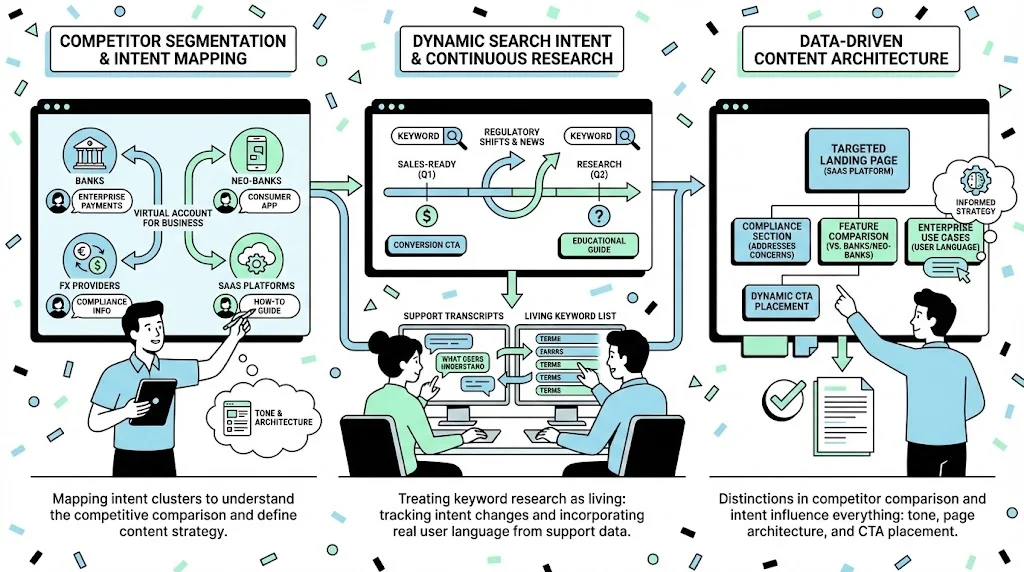
I also found that competitor segmentation plays a much bigger role than in other industries. A keyword like “virtual account for business” behaves differently depending on whether your competitors are banks, neo-banks, FX providers, or merchant-focused SaaS platforms. If you don’t know which category you’re being compared against, you end up writing content for the wrong audience. So I spend time mapping the “competitive intent clusters,” meaning: for each keyword, what does Google think the searcher wants? Compliance information? A consumer app? Enterprise payments? A how-to guide? These distinctions influence everything—from tone to page architecture to CTA placement.
Another quirk of fintech is how quickly search intent changes. A keyword that screams “sales-ready” in Q1 can turn into a research keyword in Q2 because of regulatory shifts, news events, or pricing changes among competitors. I’ve learned to treat keyword research as something that lives and breathes, not a one-time project. Sometimes I even watch customer support transcripts or onboarding drop-off notes before touching a keyword list, because those conversations tell me which terms users actually understand, and which ones come from our internal bubble.
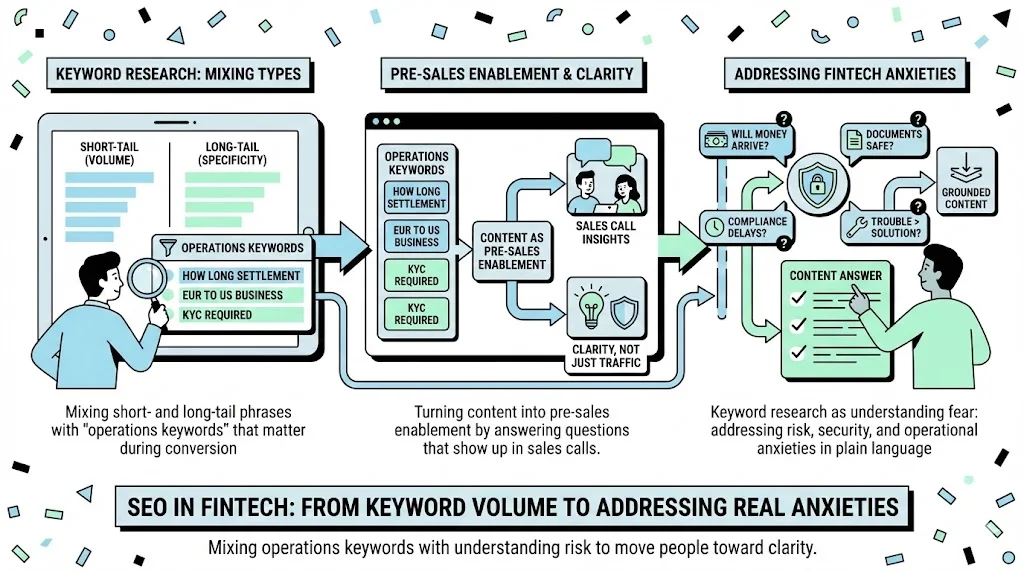
When I finally sit down to produce the list, I mix short- and long-tail phrases with what I call “operations keywords”—the terms users don’t search for often, but matter deeply during conversion. These are phrases like “how long does settlement take,” “can I receive EUR as a US business,” or “is KYC required for overseas payouts.” They won’t carry volume on paper, but they show up consistently in sales calls. Including them helps turn content into a form of pre-sales enablement, which is ultimately what SEO should do in fintech: move people toward clarity, not just traffic.
The last thing I always keep in mind is that fintech searches are rarely about curiosity. They’re about risk. People want to know if their money will arrive, if their documents are safe, if compliance delays will slow them down, and whether the provider they choose will cause more trouble than it solves. So keyword research becomes as much about understanding fear as it is about identifying opportunity. Once you see that, your content naturally starts to feel more grounded, and your SEO strategy becomes less about chasing traffic and more about answering real anxieties in plain language.
I guess that’s the part I enjoy most—the human side of it. When you strip away the dashboards and keyword difficulty tables, fintech keyword research is really just a way of listening. And the better you listen, the clearer the entire go-to-market picture becomes.
Frequently Asked Questions
Why is fintech keyword research harder than standard B2B keyword research?
Fintech queries often mix product evaluation, regulatory concern, trust assessment, and workflow urgency into the same search. That makes the intent less obvious, the language more fragmented, and the SERP landscape more sensitive to context than in simpler B2B categories.
What signals matter most when evaluating a fintech keyword?
The most useful signals are intent clarity, competitive context, query wording, and how close the search is to a real operational problem. Volume still matters, but it is rarely enough on its own because two similar keywords can represent completely different buyers.
Should low-volume operational queries still be targeted?
Yes. In fintech, low-volume operational queries often reflect real pre-sales or onboarding friction, which means they can move qualified visitors closer to action. A smaller query with stronger trust or conversion intent can be more valuable than a broad term with weak fit.
Related Expertise
If this topic overlaps with your work, these service pages show the operating systems behind it.
Related Reading
Explore a few connected notes if you want to go deeper on this topic.